
Crochet reference
How to read crochet charts.
A crochet chart is a map of the fabric seen from the right side. Once you know where it starts, which way each row or round runs and how repeats are marked, you can follow a chart in any language.
Start with the key
Every chart should come with a stitch key that pairs each symbol with a stitch name. Read it first, and note whether the names are in US or UK terms, because the same symbol keeps its meaning while its name changes. The crochet symbols chart covers the common symbols; anything unusual, such as a special cluster, is defined only in the pattern's own key.
Next, find the start. On a row chart it is the foundation chain at the bottom; on a round chart it is the ring or chain at the centre. Row or round numbers sit next to the place where each one begins.
Charts worked in rows
Read a row chart from the bottom up. The foundation chain is the lowest line, and row 1 sits directly on top of it. Right side rows are read from right to left and wrong side rows from left to right, because you turn the work at the end of every row. Printed charts often draw wrong side rows in a second colour, and the row number is placed at the end where that row begins: odd numbers on the right, even numbers on the left, when row 1 is a right side row.
The turning chain is drawn at the start of a row, standing on the edge stitch of the row below. Its length tells you whether it counts as a stitch: one chain before a single crochet row usually does not, while three chains before a double crochet row usually stand in for the first double crochet. The written pattern confirms which.
If you crochet left-handed, everything is mirrored: right side rows run from left to right. You can flip a chart in an image viewer, or simply read it in the opposite direction.
Charts worked in rounds
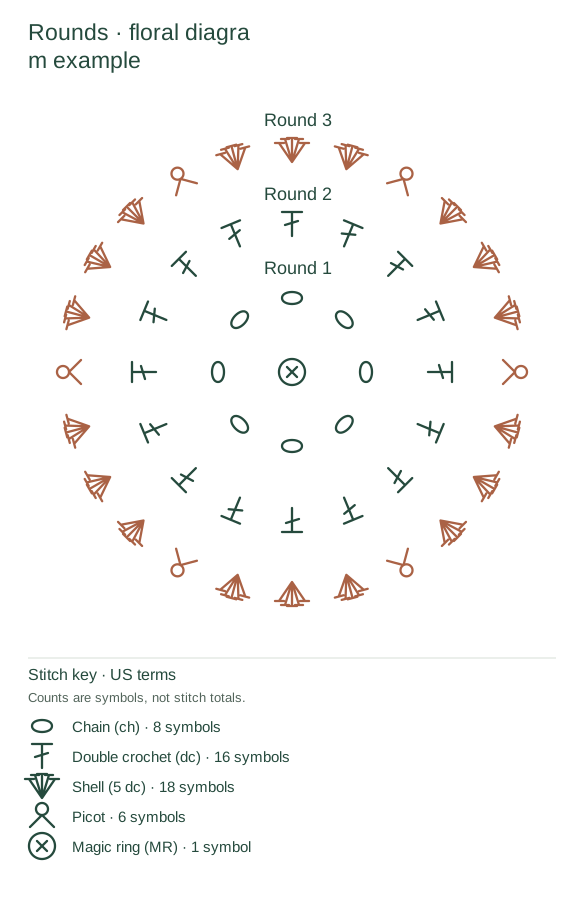
A round chart starts at the centre, usually with a magic ring or a short chain joined into a ring, and grows outwards. Right-handed crocheters work each round counterclockwise, so you read the symbols in that direction; left-handed crocheters go clockwise. The round number sits beside the first stitch of each round, often next to the beginning chain.
Most rounds end with a slip stitch, drawn as a small dot, that joins the last stitch to the top of the beginning chain. Some patterns turn the work after each round, which reverses the direction of the next round; the pattern says so if it does. Rounds can be drawn in alternating colours to make them easier to tell apart. Square motifs such as the granny square chart are still read as rounds: you simply turn each corner as you go.
Where each stitch goes
The bottom of each symbol points to the stitch or space it is worked into. When a symbol sits directly on top of another symbol, work into that stitch. When it sits over the gap beneath a chain, work into the chain space rather than into a particular chain. Several symbols that meet at one point at the bottom are all worked into the same place; symbols that meet at the top are worked off together, as in a decrease.
Repeats
Charts rarely draw an entire large piece. Instead they mark a repeat: a bracket below the chart, a shaded or outlined block, or a note such as "repeat the marked stitches 6 times". Work the stitches before the repeat once, the repeat as many times as the pattern says, then any stitches after it. On a round chart the repeat is often a single wedge or one side of a square, and the rest of the round is the same wedge turned around the centre. In written patterns the same idea is an asterisk or brackets, explained in the crochet abbreviations list.
Practice on a chart you can change
The StitchPico round diagram and row diagram include manually placed number labels. They are examples for learning the editor, not tested crochet patterns. Use Row and round numbers to add, edit or move a label; its position does not automatically determine which symbols belong to that row or round. The number-label guide covers canvas placement and the coordinate controls available on a phone.
The editor's symbol quantities count drawings, not actual stitch totals: a shell is one symbol even though its key describes several stitches. Number labels do not count as symbols. Switch Crochet terms to rename the same key in US or UK terms, then export SVG, PNG or PDF with numbers and an optional key. See symbol counts and print or export a chart with its legend for the exact limits.
Sources
- Craft Yarn Council, Crochet Chart Symbols: symbols show the right side of the work, right side rows read right to left and wrong side rows left to right, rounds work from the centre counterclockwise for right-handed crocheters.